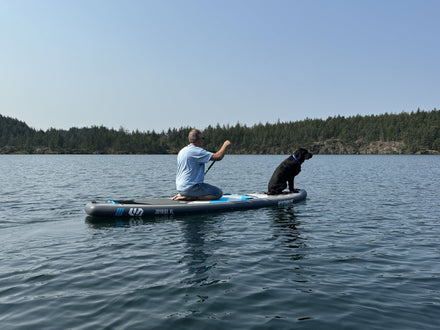
The best second paddle board is not "more advanced" than your first one. It is chosen by the water you actually paddle now and the trips you want to take, because most paddlers do not outgrow their skill level in the first season, they outgrow a wide, stable beginner board's limits on speed and glide.
A beginner all-around board is built wide and short for stability while you learn balance and stroke. Once you can stand confidently and paddle a straight line, the thing holding you back usually is not your skill, it is a board shape that was never meant to glide or track. Your second board should match the water you now paddle: longer trips, moving current, speed work, more people, more gear, or all of the above.
Did I outgrow my board, or did my paddling change?
Both, usually. You probably did not max out your skill so much as find out what kind of paddling you like. Longer lake loops, river trips, timed workouts, or family trips are a change in use, not a graduation. Ask what changed last season: more distance, moving water, chasing speed, hauling more weight, or paddling with a group. Each points to a different shape, not a single "intermediate" board.
What should I look for in a second board?
Match the shape to the use, then check your weight and gear against the board's numbers. A longer, narrower board glides farther per stroke and tracks straighter, which is what most people want when they say they are ready for something better. A shorter, wider board built for moving water trades some glide for stability and quick turning.
- Longer distance and touring: a longer, narrower hull that holds a line with less effort per stroke.
- Racing or fitness speed work: a long, narrow race hull built to be paddled hard.
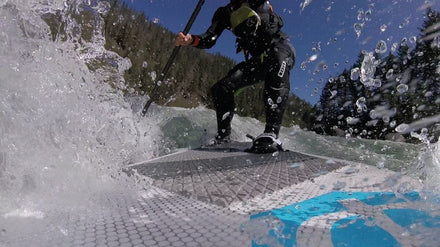
- Rivers and whitewater: a shorter, wider hull that responds quickly in current and shrugs off rock hits.
- Carrying kids, a dog, or gear: a wider, higher-capacity all-around hull with room to spare.
- Paddling with a group: a board built for multiple paddlers standing on it at once.
What's the tradeoff when I go longer and narrower?
You trade some side-to-side stability for straight-line speed and glide. A narrower board asks for a more centered stance, but it rewards you with more distance for less effort. Paddlers with real balance on a beginner board usually adapt to a narrower hull within a session or two on calm water. If you are still working on your stance, build that first; see Hydrus's guide on improving stability on your paddle board before sizing down in width.
| What changes when you go longer and narrower | What does not change |
|---|---|
| Glide per stroke goes up; you cover more distance for the same effort | You still need the same basic stance and balance fundamentals |
| Straight-line tracking improves; the board holds a line instead of wandering | You still need to match the board to your rider weight, not just the hull shape |
| Side-to-side stability drops some, especially in the first few outings | A leash and a PFD (required by the US Coast Guard once you leave surf, swim, or bathing zones) are still non-negotiable |
| Turning takes a wider arc; it is not a board for tight maneuvering | Inflation range stays in the 12 to 15 PSI window on Hydrus touring and race boards |
How do I read "best for rider weight" versus "total capacity"?
These are two different numbers, and mixing them up is the most common sizing mistake on a second board. "Best for rider weight" is the range where the board performs as designed: it sits at the right depth and tracks well. "Total capacity" is the maximum combined weight of you, a passenger, a dog, and your gear before the board rides low and sluggish. You can be under total capacity and still be near the top of a board's rider-weight range.
The Paradise Touring is built for paddlers up to 250 lbs with gear and carries a 300 lb total capacity, while the JoyRide XL is rated for riders up to 300 lbs with a 400 lb total capacity because it is built wider for stability and loaded touring. Two boards can share a similar length and still fit very different paddlers, because rider weight and total capacity are set by width and volume, not just length. See Hydrus's paddleboard weight capacity explained and the SUP size guide if you are unsure what fits you.
Which board fits my goal?
Longer distance paddling and touring. The Paradise Touring (12'6" x 30" x 6", up to 250 lbs with gear, 300 lb total capacity) fits lake touring, river exploration, coastal cruising, and fitness paddling. For serious distance days, Hydrus also builds the Paradise X Performance Touring (13'3" x 28.5" x 6", up to 230 lbs, 290 lb total capacity), a narrower, faster hull for endurance fitness and long-day paddling. See Hydrus's touring paddleboard guide and planning a long-distance trip.
Racing or fitness speed work. The Elysium Air Race (14' x 26.5" x 6", up to 230 lbs, 275 lb capacity, 15 to 20 PSI, Armalight Air with carbon fiber stringers) is built for racing, fitness, distance, and speed work. See Hydrus's introduction to paddle board racing before committing to a race shape.
Rivers and whitewater. The AXIS 98 Whitewater (9'8" x 35.5" x 6", up to 250 lbs with gear, 350 lb total capacity) fits river paddling, whitewater class I to IV, fishing, and mixed day trips. Hydrus also builds the AXIS 88 Whitewater Freestyle (8'8" x 34.5" x 6", up to 250 lbs with gear, 300 lb capacity) for freestyle, tight rapids, and surf-style play in current. Check Hydrus's best paddle board for rivers guide and navigating a paddle board on a river, and use a quick-release waist leash in current, never an ankle leash.
Carrying kids, a dog, or gear. The JoyRide XL (11'6" x 34" x 6", up to 300 lbs, 400 lb total capacity) fits family use, maximum stability, yoga, and loaded multi-day touring. If your second-board need is really "enough capacity left over for a passenger or a dog," this is a width-and-capacity upgrade, not a performance one. See best paddle board for families and best paddle board for paddling with dogs.
Groups and multi-paddler use. The Party Board (14' x 50" x 6", 1,000 lb total capacity) is built for multiple paddlers standing on it at once: lake house groups, fishing crews, yoga groups. This solves a different problem than solo progression; one single-rider board cannot fit a group.
Does my paddle need to change too?
Yes, and this gets skipped more than any other upgrade. A paddle sized or weighted for a wide beginner board will slow you down and tire your shoulders on a longer, narrower hull, where stroke efficiency matters more. Hydrus's Adjustable Tough Blade Carbon Paddle has a carbon shaft and an Armalight composite blade built to take rock hits, adjusts from 65 to 87 inches, breaks into 3 pieces, weighs 26 oz, and rides inside the Mothership backpack, a practical match for a touring or river board shared across conditions and paddlers. No paddle ships included with any Hydrus board; it is always a separate purchase. See Hydrus's paddle buying guide.
When should I NOT buy a new board yet?
If you are still working on fundamentals, a stable all-around board is still the right board; a longer or narrower hull will fight you more than it helps. If your real complaint is that your board feels unstable in wind or chop rather than slow, that is often a stance and technique issue, not a shape problem; work through Hydrus's beginner paddle boarding tips first. If you are not sure what you will paddle most next season, it is fine to spend one more season on your current board and notice what you keep wishing it did better. That answer is your second board.
If you buy and it turns out to be the wrong shape, Hydrus's 60-Day On-Water Trial lets you paddle it on your own water and exchange it for any other Hydrus board within 60 days with no restocking fee, or return it for a refund within 60 days (return shipping is on you, a 20% restocking fee applies, and the board needs to come back in reasonable trial-use condition with its included gear). Every Hydrus inflatable carries the Limited Lifetime Warranty against manufacturing defects, and Hydrus boards are Idaho Tested. Text the Hydrus Crew at (208) 408-1997 before ordering for a straight answer on which shape fits your trip.
Frequently asked questions
What is the best second paddle board after outgrowing a beginner board?
There is no single best second board, there is a best shape for your water. Longer, narrower hulls like the Paradise Touring or Paradise X fit distance and touring; a race hull like the Elysium Air Race fits speed work; shorter, wider river hulls like the AXIS 98 or AXIS 88 fit whitewater; a wider board like the JoyRide XL fits loaded family use; and a multi-paddler board like the Party Board fits groups. Match your second board to the trips you actually take now, not to a generic advanced label.
Did I outgrow my beginner board's skill level or its width?
Usually the width, not your skill. A beginner all-around board is built wide and short for stability while you learn balance. Once you can paddle confidently, what holds you back is typically glide and tracking, which comes from length and a narrower hull, not a higher skill tier.
What's the difference between "best for rider weight" and "total capacity"?
Rider weight is the range where the board performs as designed and sits at the right depth. Total capacity is the maximum combined weight of rider, passenger, dog, and gear before the board rides low and sluggish. You can be under total capacity and still be near the top of the board's ideal rider-weight range, so check both numbers.
Does a longer, narrower board feel less stable?
Yes, somewhat, especially in the first few outings. You trade some side-to-side stability for straight-line glide and tracking. Paddlers who already have solid balance on a beginner board typically adapt within a session or two on calm water.
Do I need a new paddle when I upgrade my board?
Often, yes. A paddle sized for a wide beginner board can slow you down on a longer, more efficient hull where stroke technique matters more. An adjustable carbon paddle like Hydrus's Adjustable Tough Blade Carbon Paddle lets one paddle fit a touring or river board across different conditions and paddlers.
What if I buy a second board and the shape turns out to be wrong for my water?
Hydrus's 60-Day On-Water Trial lets you paddle it on your own water and exchange it for any other Hydrus board within 60 days with no restocking fee, or return it for a refund within 60 days under the program's terms. Text the Hydrus Crew at (208) 408-1997 before ordering if you want a second opinion on the shape.